Have you ever walked up to the pharmacy counter, handed over your prescription, and felt your heart sink when the pharmacist told you the total?
If you have, you are far from alone. Millions of Americans experience “sticker shock” at the pharmacy every single day. As a healthcare and pharmaceutical savings expert, I have spent years analyzing the complex web of drug pricing. I’ve seen patients skip doses, split pills, or walk away from life-saving medications simply because the out-of-pocket cost was too high.
But here is the industry secret you need to know: Prescription prices are not fixed. The exact same medication can cost wildly different amounts depending on which pharmacy you visit, whether you use insurance, and what discount tools you have in your pocket. Today, I am pulling back the curtain on how pharmacy pricing actually works and showing you exactly how to use RxGo to protect your wallet.
The Secret of Pharmacy Pricing: Why Do Costs Vary So Much?
To understand how to save, you first need to understand why prices are so confusing. When you buy a gallon of milk, the price is relatively similar whether you go to the grocery store down the street or the one across town. Prescription drugs do not follow this logic.
The price of a medication is influenced by middlemen known as Pharmacy Benefit Managers (PBMs). These entities negotiate contracts between drug manufacturers, insurance companies, and pharmacies. Because every pharmacy chain has different contracts, different purchasing power, and different business models, the “retail price” or “cash price” of a drug can vary by tens, or even hundreds, of dollars from one corner store to the next.
Furthermore, if you are using insurance, your “copay” is dictated by your specific plan’s formulary (their list of covered drugs). If your medication is on a lower tier, or if you haven’t met your deductible, you bear the brunt of that cost.
The Foundation of Savings: Embracing Generics
Before we even talk about discount cards, we have to talk about generics.
When a pharmaceutical company develops a new drug, they are granted a patent. Once that patent expires, other manufacturers can produce the exact same medication, known as a generic.
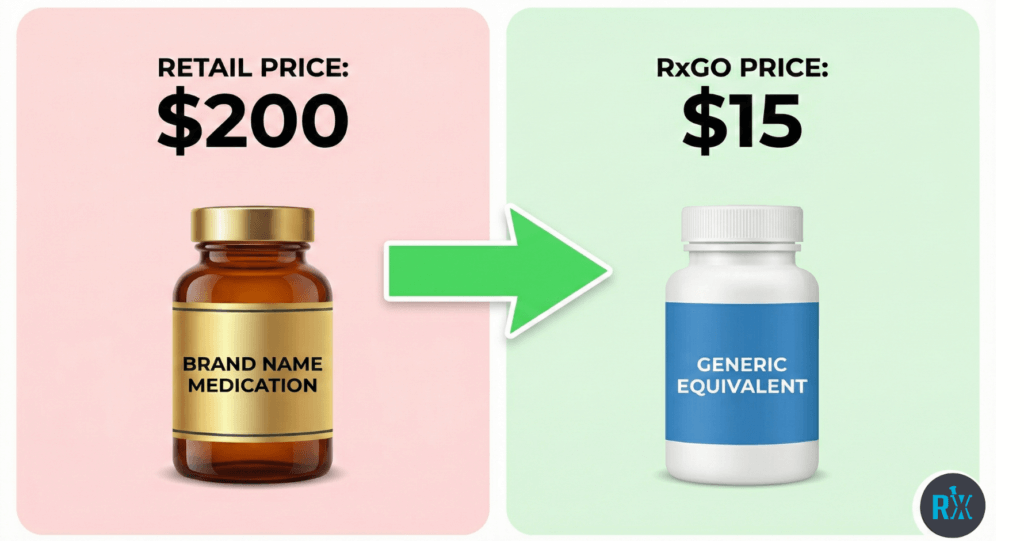
By law, the FDA requires generic medications to have the exact same active ingredients, strength, dosage form, and route of administration as the brand-name product. They must work in the exact same way in the body. The only difference? The price. Because generic manufacturers do not have to repeat the costly clinical trials for safety and effectiveness, they can sell the drug for a fraction of the cost. Generic medications can often be up to 80% cheaper than their brand-name counterparts.
Expert Tip: Always ask your doctor, “Is there a generic equivalent for this medication?” If there is, it is the easiest first step to massive savings.
The Myth of the Insurance Copay
Here is the biggest misconception in modern healthcare: “I have insurance, so my copay is definitely the cheapest price available.”
This is false.
In many cases, the cash price of a generic medication—when paired with a prescription discount network like RxGo—is actually lower than your insurance copay. If you have a high-deductible health plan (HDHP), you might be paying the full, inflated retail price until you meet a deductible of thousands of dollars.
Even if you have great insurance, certain medications (like lifestyle drugs, weight loss medications, or specific dermatological creams) might not be covered at all. This is where you have to advocate for yourself.
How RxGo Levels the Playing Field
As an expert in this field, I joined the RxGo team because I believe transparency is the ultimate cure for high drug prices. RxGo bypasses the traditional insurance maze. We have negotiated heavily discounted rates directly with pharmacy networks across the nation—including major chains and local independents.
Here is exactly how you can use RxGo to take control of your costs:
1. Search Before You Drive Never walk into a pharmacy blindly. Before you leave your doctor’s office, go to RxGo.com. Type in the name of your medication, adjust the dosage and quantity to match your prescription, and enter your zip code.
2. Compare the Market RxGo will instantly generate a list of prices at pharmacies in your immediate area. You will clearly see the price differences. A generic medication might be significantly cheaper at the grocery store pharmacy than at the big-box pharmacy across the street.
3. Show the Digital Card There is no paperwork, no approval process, and no membership fee. You simply choose the pharmacy with the best price, request your prescription be sent there, and show the pharmacist the RxGo coupon on your smartphone when you check out. They will enter the specific codes on the screen, and you will pay the discounted price.
3 Pro-Tips to Maximize Your Pharmacy Savings
To truly optimize your healthcare budget, combine your RxGo usage with these insider strategies:
- Ask for a 90-Day Supply: If you take a maintenance medication for a chronic condition (like high blood pressure or cholesterol), ask your physician to write the prescription for a 90-day supply instead of 30 days. Pharmacies often offer better pricing on bulk fills, reducing your cost-per-pill and saving you trips to the store.
- Talk to Your Pharmacist: Pharmacists are incredibly knowledgeable healthcare advocates. When picking up your medication, simply ask: “Can you check the price using my insurance, and then check it using this RxGo code? I want to go with whichever is cheaper.” They are usually more than happy to help you find the lowest out-of-pocket cost.
- Look into Pill Splitting (With Medical Approval): Sometimes, a higher milligram pill costs the exact same as a lower milligram pill. If your doctor approves, they can prescribe the higher dose, and you can use a pill splitter to divide them, effectively cutting your medication costs in half. Note: Never do this without explicit approval from your doctor and pharmacist, as some extended-release capsules cannot be split safely.
Your Next Steps
You no longer have to be at the mercy of unpredictable pharmacy pricing. By understanding the value of generics, questioning your insurance copay, and utilizing digital comparison tools, you are in the driver’s seat.
Do not pay retail price for your next refill. Search RxGo.com today, search your medication, and see exactly how much you can save. Your health is your most valuable asset—let’s make sure you can afford to protect it.
Disclaimer: The information provided in this article is for educational and informational purposes only and does not constitute medical advice. Always consult with a qualified healthcare provider regarding any changes to your medications or treatment plans. RxGo is a prescription discount program, not an insurance plan.
Note: The information provided in this article is for educational purposes only and should not be substituted for professional medical advice. Always consult with your healthcare provider for personalized guidance and treatment options.